
_Commissioner champions maternal and child nutrition, sustainable food production and household empowerment as Enugu State Government and UNICEF train health workers and community caregivers.
_
The Enugu State Government, in partnership with the United Nations Children’s Fund (UNICEF), has intensified efforts to combat childhood malnutrition and reduce household poverty through a four-day capacity-building programme focused on nutrition during the first 1,000 days of a child’s life.
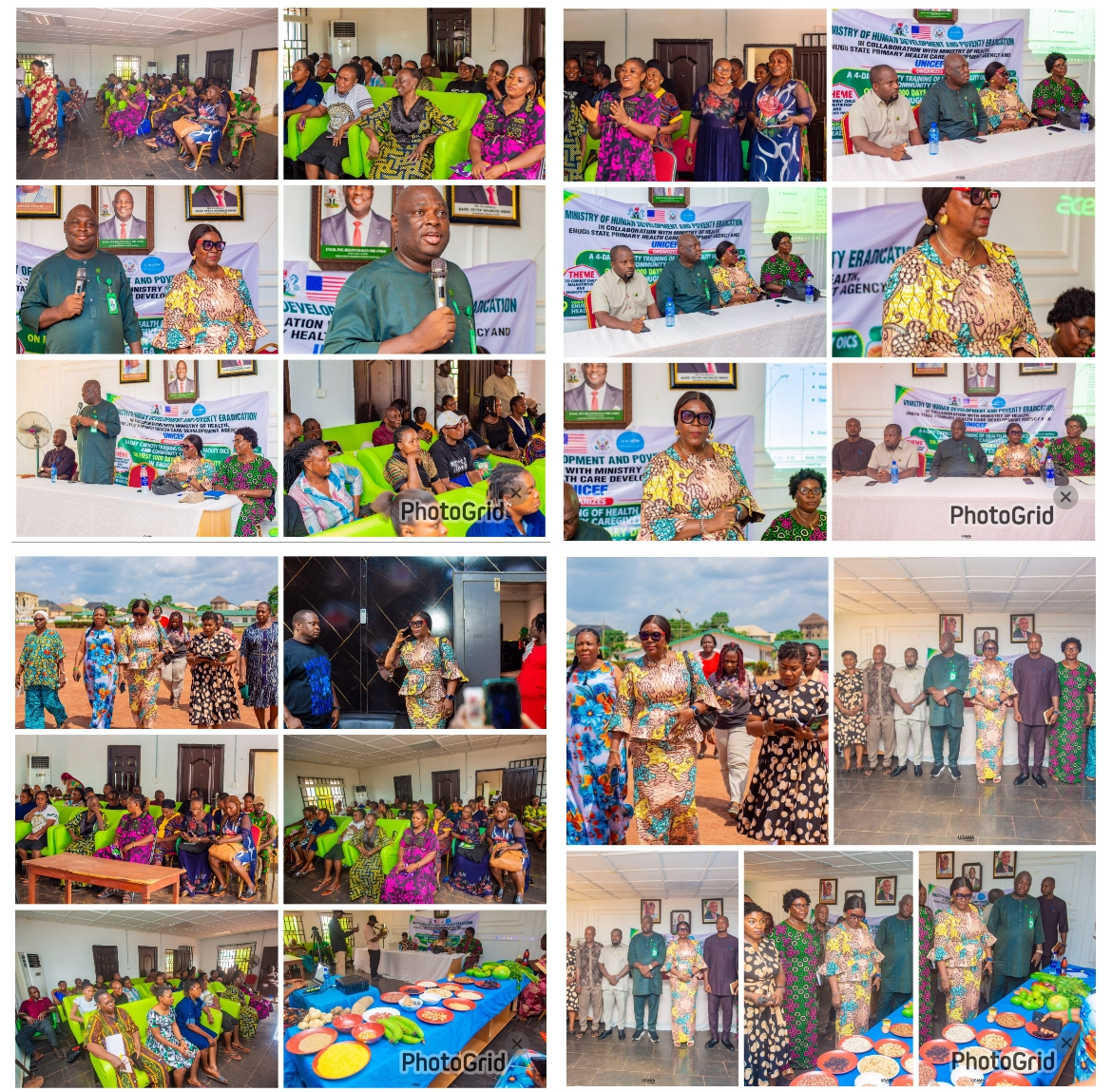
The initiative, which was flagged off on Friday, October 9, 2026, at the Enugu East Local Government Area Headquarters, is being coordinated as part of broader efforts to strengthen maternal, infant and young child nutrition, improve household food security and equip frontline health workers and community caregivers with practical skills for sustainable family nutrition.
At the centre of the initiative is the Honourable Commissioner for Human Development and Poverty Eradication, Professor Benedett Ekwutosi Okoli, who has emphasised the importance of adequate nutrition during the critical period from conception until a child reaches two years of age.
The programme is designed to equip health facility officers-in-charge, community caregivers and other participants with practical knowledge of dietary diversity, animal husbandry, year-round crop production and the effective utilisation of locally available food resources.
It also seeks to promote food processing, appropriate food combinations and the preparation of balanced, nutritious meals that can improve the health and well-being of mothers, infants and young children while helping families make better use of available resources.
PROF. OKOLI EMPHASISES CRITICAL IMPORTANCE OF FIRST 1,000 DAYS
Speaking during the flag-off ceremony, Professor Okoli underscored the significance of proper nutrition during the first 1,000 days of a child’s life, explaining that the period, which begins at conception and continues until the child’s second birthday, is fundamental to physical growth, good health and mental development.
The Commissioner stressed that adequate nutrition during this formative stage is essential to giving children a healthier start in life, while also supporting the state’s broader efforts to tackle poverty and improve household welfare.
She called on participants to embrace teamwork and collective responsibility, encouraging them to work together in groups to strengthen cooperation, promote sustainability and maximise the benefits of the intervention.
According to her, the programme is intended to go beyond the transfer of knowledge by equipping beneficiaries with practical skills that can be applied within their homes and communities.
In an exclusive interview with UGAMATV, Professor Okoli reaffirmed the state government’s commitment to sustaining the initiative through its partnership with UNICEF.
She disclosed that plans were being made to encourage participants to establish cooperative societies, creating a platform through which they could work collectively, strengthen their activities and improve the long-term benefits of the programme.
The Commissioner also highlighted the importance of continuous monitoring and evaluation, explaining that a platform would be established to assess the effectiveness of the initiative, track its progress and support its sustainability.
Professor Okoli noted that the government’s objective was to ensure that participants translated the knowledge and skills acquired during the training into practical activities capable of improving household nutrition, supporting food production and enhancing livelihoods.
Her emphasis on practical implementation reflects the programme’s integrated approach to human development, which links nutritional education with sustainable agriculture, household empowerment and poverty reduction.
ANIKE PLEDGES AGRICULTURAL LAND, EMPOWERMENT SUPPORT
Also speaking at the event, the Executive Chairman of Enugu East Local Government Area, Hon. Pastor Beloved Dan Anike, expressed appreciation to the Enugu State Government and Professor Okoli for bringing the initiative to the council.
He described the programme as an important opportunity to strengthen food security by encouraging households to cultivate, process and utilise locally available food resources for improved nutrition and poverty reduction.
In support of the state government’s human capital development and poverty eradication agenda, Anike pledged to provide empowerment support and agricultural land to participants to encourage increased food production and promote proper nutrition among families.
The commitment is expected to give beneficiaries opportunities to put their newly acquired skills into practice, expand local food production and improve access to nutritious meals within their communities.
The council chairman’s pledge also reinforces the importance of collaboration between the state and local governments in translating nutrition education into practical community-level interventions.
TRAINING EQUIPS PARTICIPANTS WITH PRACTICAL NUTRITIONAL KNOWLEDGE
Providing an overview of the training, the State Nutrition Officer, Mrs. Onwuzuluike Loveth, highlighted the major activities and objectives covered during the first three days of the four-day programme.
She explained that the sessions focused on equipping participants with the knowledge and practical skills required to promote appropriate maternal and child nutrition through sustainable food production and the effective use of locally available food sources.
The training also exposed participants to the importance of dietary diversity and the appropriate combination of different food items to provide balanced meals for mothers, infants and young children.
By linking nutritional education with food production, processing and household practices, the initiative seeks to help families make informed dietary choices while maximising the nutritional value of available resources.
The approach is expected to strengthen the capacity of frontline health workers and community caregivers to share practical nutrition information with families, particularly expectant mothers and caregivers of young children.
BENEFICIARIES COMMEND INITIATIVE
One of the beneficiaries, Mrs. Ugwu Onyinyechi, expressed appreciation to the organisers, describing the training as an opportunity to acquire valuable knowledge about childcare and nutrition.
She said the programme had deepened her understanding of the importance of caring for a child from conception through the first 1,000 days of life.
According to her, the lessons covered exclusive breastfeeding, the introduction of nutrient-dense complementary foods at the appropriate stage and the proper combination of food items to achieve a balanced diet.
Her remarks highlighted the practical value of the training in helping caregivers understand how appropriate feeding practices can contribute to the healthy development of children.
Similarly, the Senior Special Assistant to the Enugu East Local Government Chairman, Mrs. Ekete Nnenna, commended the organisers for the initiative and urged participants to apply the knowledge gained in their respective communities.
She encouraged the beneficiaries to become agents of social enlightenment by educating other mothers, caregivers and households on proper nutrition and the importance of preventing childhood malnutrition.
She noted, in effect, that extending the lessons beyond the training venue would help more families benefit from the programme and promote greater awareness of appropriate maternal and child feeding practices.
UNICEF CALLS FOR SUSTAINED COMMITMENT
In her closing remarks, UNICEF programme nutrition facilitator, Emmanuella Okechukwu, welcomed the Commissioner and the Enugu East council chairman, appreciating their support for the initiative.
She called for sustained commitment and local ownership to ensure that the programme achieves its objectives and delivers lasting benefits to participating communities.
Her appeal reinforced the importance of continued collaboration among the state government, local government authorities, UNICEF, health workers, community caregivers and beneficiaries.
Such cooperation is considered essential to ensuring that the knowledge gained during the training is consistently applied and shared across households and communities.
INITIATIVE TO EXTEND TO OTHER LOCAL GOVERNMENT AREAS
Beyond Enugu East, the initiative is expected to be implemented in other local government areas of Enugu State, including Aninri and Oji River, to broaden its reach and enable more communities to benefit from the intervention.
The planned expansion is expected to extend nutritional education, promote sustainable food production and strengthen community participation in efforts to improve maternal and child health.
With continued government support, effective collaboration with UNICEF and active participation by beneficiaries, the programme offers an opportunity to strengthen household food security, reduce the risk of childhood malnutrition and improve the well-being of mothers and children across the state.
For Professor Okoli’s Ministry, the initiative also provides a practical platform for connecting human development and poverty eradication with improved nutrition, community empowerment and sustainable household livelihoods.
Ultimately, investing in nutrition during the first 1,000 days of life represents an investment in healthier children, stronger families and the future well-being of Enugu State.