

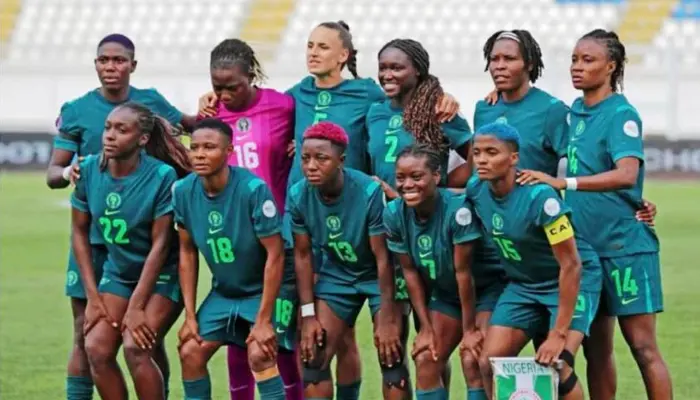
Nigeria’s Super Falcons endured a disappointing campaign at the 2026 CAF Women’s Africa Cup of Nations, WAFCON, in Morocco, crashing out at the quarter-final stage after a 1-0 defeat to arch-rivals Cameroon.
The setback was followed by another disappointment as Nigeria lost 2-1 to South Africa in the African play-off for the 2027 FIFA Women’s World Cup. The result means the Super Falcons will miss the World Cup in Brazil, ending their record of appearing at every edition of the competition since its inception in 1991.
Following the team’s poor showing, the Nigeria Football Federation, NFF, on Monday asked head coach Justine Madugu and members of his technical crew to step down with immediate effect.
Speaking on the team’s performance, Saheed Afolabi of Echonews identified inadequate preparation and insufficient camping as major reasons for the Falcons’ failure.
According to Afolabi, expectations were particularly high because Nigeria entered the tournament as defending champions and the most successful team in the history of the WAFCON, having won the title a record 10 times.
He argued that the team’s preparation was inadequate, noting that the Falcons only began camping about three or four days before the tournament.
Afolabi said the NFF should have provided a longer camping period, potentially starting one or two months before the competition, to allow the technical crew enough time to prepare the players and build a stronger team.
He acknowledged that some players arrived late because they were still participating in the ongoing United States women’s league, but noted that only about four or five Falcons players were affected.
According to him, most of the other players had been available since their club seasons ended in May, giving the NFF enough opportunity to begin preparations earlier.
Afolabi said the lack of adequate preparation may have contributed significantly to the team’s poor performance, adding that there appeared to have been an assumption that Nigeria would easily overcome its opponents.
He described the failure to qualify for the 2027 World Cup as a major disappointment and a bitter lesson for Nigerian football.
Afolabi, however, urged the NFF, coaches and players to learn from the setbacks and ensure that similar mistakes are not repeated.
He said the experience should serve as an opportunity to rebuild the Super Falcons and prepare them properly for future international competitions.
The absence from the 2027 FIFA Women’s World Cup marks a significant setback for Nigeria’s women’s football, given the Falcons’ unbroken participation in every previous edition of the tournament since 1991.