

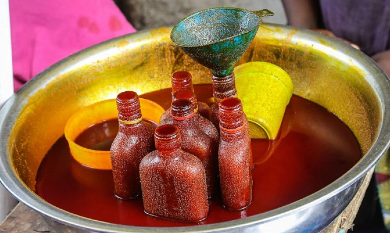
Palm oil and ground pepper, or ata gigun, are staples in millions of Nigerian homes. But growing concerns over food adulteration have raised questions about the safety of some products sold in open markets.
Investigations have uncovered allegations that some unscrupulous traders and processors mix low-grade or diluted palm oil with non-food substances, including industrial dyes, candle wax, pap and starch, to give it a thicker texture and deeper red colour.
Similar allegations have emerged in the ground pepper market, where spoiled pepper remnants, dried stems, cassava flour and other materials are reportedly mixed into pepper and coloured with substances such as textile dyes and kolanut to enhance its appearance.
An experienced Lagos palm oil seller, identified as Mama Ochuko, said genuine palm oil is not usually extremely red and has a characteristic fresh palm kernel smell. She said adulterated oil may appear unnaturally bright, feel heavy or sticky in the mouth and change the colour of food when used for cooking.
She advised consumers to buy from trusted vendors rather than constantly switching between sellers, noting that many buyers may not know how to identify adulterated products.
A palm oil wholesaler in Abeokuta, Fadairo Yusuf, alleged that some distributors mix palm oil with cooked cornstarch to increase its volume and thickness. He said he sometimes has to re-cook the oil he purchases to remove excess water, resulting in losses.
Yusuf blamed some urban wholesalers rather than rural producers for the practice, alleging that genuine palm oil is sometimes adulterated after being transported to major cities.
Another distributor, Francis Ikechukwu, also alleged that some suppliers add colouring agents to palm oil and ground pepper. He said adulterated oil may separate when heated and alter the colour of food.
High Price Does Not Guarantee Quality
A market survey cited by DAILY POST found that adulterated palm oil is not necessarily sold at cheaper prices. Traders reportedly sell the products at prices similar to, and sometimes higher than, genuine palm oil.
According to the traders interviewed, 25-litre containers were selling for between N47,000 and N51,000, depending on the vendor and period.
Mama Ochuko said price alone could not be used to determine whether palm oil was genuine, noting that she purchased 25 litres of original oil for N47,000 and sourced it directly from Badagry.
Regulators Raise Concerns
The Lagos State Consumer Protection Agency (LASCOPA) raised an alarm in May over allegedly adulterated palm oil and sealed a shop on Idutafa Lane, Lagos Island, over the reported sale of the product.
LASCOPA General Manager, Afolabi Solebo, said substances allegedly found in adulterated palm oil included candle wax, chemicals, dyes and other impurities. He warned that consumption could pose health risks and said offenders would face sanctions.
Similar concerns were raised in Anambra in August after consumers reported allegedly adulterated palm oil in markets including Onitsha, Awka and Nnewi.
Joe Onyiuke, President of the Oil Palm Growers Association of Nigeria (OPGAN), described the reported scale of adulteration as a “national disaster” and “national emergency,” while calling for stronger market surveillance.
NAFDAC Warns Against Relying on Social Media Tests
The issue gained widespread attention in August after videos circulated online appearing to show palm oil separating when mixed with water or leaving coloured stains on cooking utensils.
However, NAFDAC Director-General, Prof. Mojisola Adeyeye, cautioned Nigerians against treating social media videos as conclusive evidence that a food product is adulterated.
She said determining whether palm oil or another food product contains harmful substances requires proper laboratory analysis, adding that unverified social media claims can be commercially motivated.
Adeyeye nevertheless acknowledged that food adulteration involving hazardous dyes and other chemicals remains a serious public health concern. She urged Nigerians to report suspicious products to NAFDAC, which can seize, recall or dispose of products and take enforcement action when violations are confirmed.
Doctor Warns of Potential Health Risks
Chief Medical Officer at the Federal Medical Centre, Abeokuta, Dr Kunle Ashimi, warned that consuming industrial dyes and other non-food chemicals over prolonged periods could cause serious health problems.
He said substances such as Sudan dyes, Rhodamine B and Metanil Yellow are intended for industrial applications and should not be used in food.
According to Ashimi, prolonged exposure to such substances may affect organs including the liver and kidneys and could cause gastrointestinal problems and other adverse health effects.
He called for greater public awareness, stronger food testing systems and stricter enforcement against traders and processors involved in food adulteration.
NAFDAC Explains Limits With Unbranded Products
The Ogun State NAFDAC Coordinator, Akinwale Fagoroye, said unlabelled palm oil and other products sold in open containers are not directly within the agency’s primary regulatory scope, which focuses largely on packaged and labelled products.
He also cautioned that the natural reddish colour of palm oil makes it difficult to determine visually whether prohibited dyes have been added.
Fagoroye said laboratory testing is required to establish adulteration, while assuring that NAFDAC enforcement teams continue to conduct market surveillance and shut down non-compliant businesses.